Backlash error in a screw gauge
On this page
A screw turning in a nut always has a little play between the threads. In a worn screw gauge that play, called backlash, means a turn of the thimble does not always move the spindle. This guide shows when that changes a reading, by how much, and the one habit that avoids it.
Where backlash comes from
The thimble is fixed to the screw, and the screw turns in a nut inside the sleeve. If the threads fit loosely, reversing the thimble first turns the screw through the gap between the threads before they press on the other side. During that part of a turn the thimble, and so the circular scale, turns, but the spindle does not move. The scales then read a different value from the true gap.
An example
The simulator's Worn: slack screw has 3 divisions of slack. Close it onto the copper wire with the ratchet and it reads 0.71 mm: closing pushes the spindle onto the wire, so the reading is right. Now turn the thimble back by two divisions, as if to ease off. The spindle stays on the wire, but the scales read 0.73 mm.
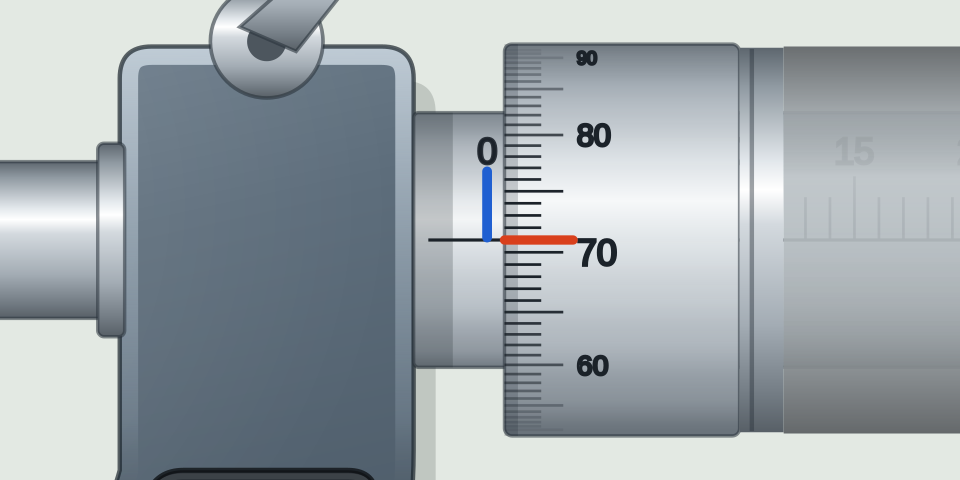
The error is never more than the slack, here 0.03 mm, but on a 0.71 mm wire that is a large share.
How to avoid it
- Close the same way every time. Bring the spindle onto the object (and onto the anvil for the zero check) by closing, never by opening back to it.
- Finish with the ratchet until it clicks, then read. Do not turn back a little before reading.
- When finding the pitch, turn the thimble in one direction while you count turns.
School practical write-ups put it as a precaution: move the screw in the same direction for a set of readings to avoid backlash error.
Feel it in the simulator
Open the screw gauge with a worn screw and the copper wire. Close it with the ratchet, then press + once or twice: the reading changes while the spindle stays on the wire. Close again with the ratchet and the right reading returns.
Questions about backlash
What is backlash error in a screw gauge?
The error caused by slack between the screw and the nut it turns in. When the thimble is turned back the other way, it turns a little before the spindle starts to move, so the scales change while the spindle stays still.
How do you avoid backlash error?
Turn the screw in one direction only for a set of readings: always close onto the object (and onto the anvil for the zero check) the same way, finishing with the ratchet. Never turn back a little and read.
Is backlash error systematic or random?
It depends on how the gauge is used. Closing the same way every time removes it. Reversing at random adds an error of up to the size of the slack, sometimes and not others.
How big can backlash error be?
Up to the size of the slack. On the simulator's worn screw that is 3 divisions, 0.03 mm. Real gauges vary; a good one has very little.
Sources
- To measure diameter of a given wire using screw gauge, LearnCBSE.in. Checked 22 November 2026.
This site is independent and is not affiliated with any maker of measuring instruments.