Least count of a screw gauge
On this page
The least count of a screw gauge is the size of one scale step: how far the spindle moves when the thimble turns by one division. Divide the pitch by the number of divisions on the circular scale to find it.
The formula
least count = pitch ÷ number of circular-scale divisions
The pitch is the distance the spindle moves in one complete turn of the thimble. One turn passes every division on the circular scale, so one division moves the spindle one pitch divided by the number of divisions.
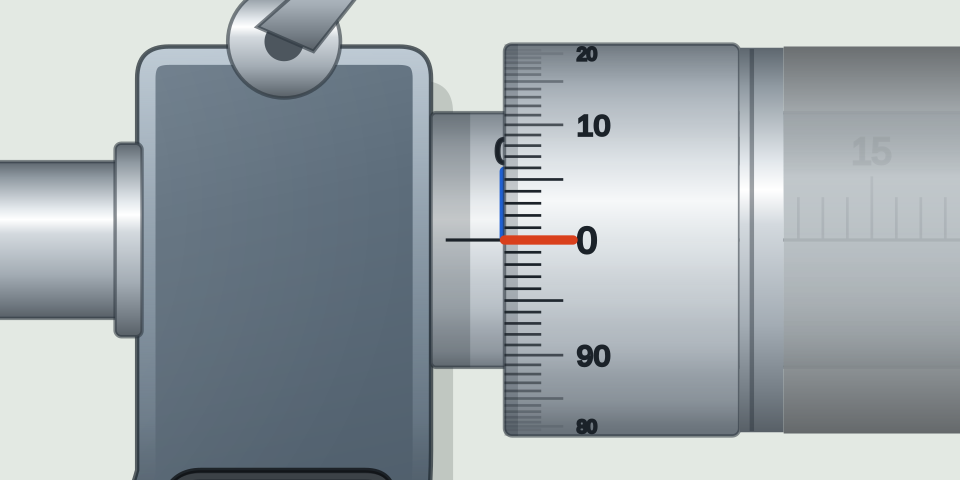
How to find the pitch
- Note the main-scale reading with the thimble at a known position.
- Turn the thimble a counted number of complete turns (say 4), always in the same direction.
- Note the main-scale reading again. The distance moved divided by the number of turns is the pitch.
On the school screw gauge, 4 turns move the spindle 4.00 mm. Divide that distance by 4 to get the pitch, 1 mm. In the simulator's Measure mode, press Start counting in the notebook, turn the thimble whole turns and the notebook works out the pitch for you. Try it.
Least count chart for screw gauges and micrometers
| Instrument | Pitch | Divisions | Least count |
|---|---|---|---|
| Screw gauge | 1 mm | 100 | 0.01 mm |
| Micrometer | 0.5 mm | 50 | 0.01 mm |
| Inch micrometer | 0.025 in | 25 | 0.001 in |
On the inch micrometer, one turn moves the spindle 0.025 in. Divide 0.025 in by 25 to get 0.001 in per division. A vernier micrometer adds a vernier scale on the sleeve, read against the thimble lines, which lets it read to 0.001 mm on a metric micrometer (0.0001 in on an inch one).
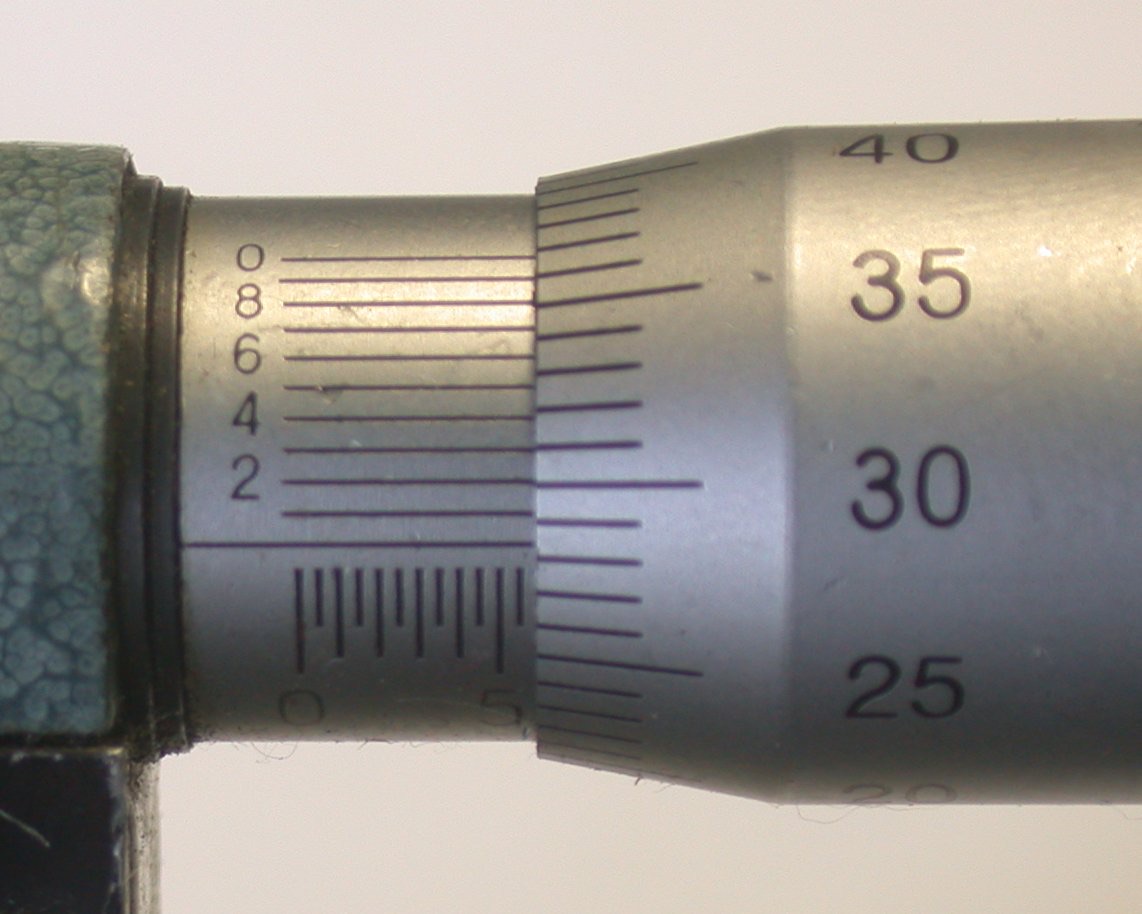

Micrometre symbol (µm)
The word micrometer can name the instrument or a unit of length, also spelled micrometre. The symbol µm joins the SI prefix µ (micro, one millionth) to m (metre). The metric micrometer above has a least count of 0.01 mm, which is 10 µm.
Solved examples
The spindle moves 1 mm in 1 complete turn, and the circular scale has 100 divisions. Find the least count.
Pitch = 1 mm ÷ 1 = 1 mm. Least count = 1 mm ÷ 100 = 0.01 mm (0.001 cm).
The spindle moves 3 mm in 6 complete turns, and the circular scale has 50 divisions. Find the least count.
Pitch = 3 mm ÷ 6 = 0.5 mm. Least count = 0.5 mm ÷ 50 = 0.01 mm (0.001 cm).
The spindle moves 2 mm in 4 complete turns, and the circular scale has 100 divisions. Find the least count.
Pitch = 2 mm ÷ 4 = 0.5 mm. Least count = 0.5 mm ÷ 100 = 0.005 mm (0.0005 cm).
The spindle moves 5 mm in 5 complete turns, and the circular scale has 50 divisions. Find the least count.
Pitch = 5 mm ÷ 5 = 1 mm. Least count = 1 mm ÷ 50 = 0.02 mm (0.002 cm).
Whatever the pair, the method is the same: find the pitch, then divide it by the number of circular-scale divisions.
Least count is not accuracy
A gauge that reads to 0.01 mm does not guarantee readings within 0.01 mm of the true size. Dirt on the faces, too much force, the warmth of your hand, a zero error and slack in the screw all move a reading. That is why a practical checks the zero, closes with the ratchet, and repeats each reading at several places before taking the mean with its uncertainty, as the experiment guide shows.
Practise
Pitch and least count: five questions like the examples above, with feedback after each answer.
Questions about least count
What is the least count of a screw gauge?
It is the distance the spindle moves when the thimble turns by one circular-scale division: least count = pitch ÷ number of circular-scale divisions. For the school screw gauge in the simulator, 1 mm ÷ 100 = 0.01 mm.
What is the pitch of a screw gauge?
The distance the spindle moves in one complete turn of the thimble. Find it by turning the thimble a counted number of whole turns and dividing the distance moved on the main scale by the number of turns.
What is the difference between pitch and least count?
The pitch is how far the spindle moves in one complete turn of the thimble (1 mm on the simulator’s school screw gauge). The least count is how far it moves for one circular-scale division: the pitch divided by the number of divisions, 1 mm ÷ 100 = 0.01 mm. Two gauges can have the same least count with different pitches: a 0.5 mm pitch and 50 divisions also give 0.01 mm.
What is the least count of a screw gauge in cm?
0.01 mm = 0.001 cm. A reading is then written with three decimal places in centimetres.
Is the least count the accuracy of a screw gauge?
No. The least count is the smallest step you can read. How close a reading is to the true size also depends on the force used, the cleanliness of the faces, temperature, any zero error and the condition of the screw.
Why does a micrometer with a 0.5 mm pitch have 50 divisions?
So one division is still 0.01 mm: 0.5 mm ÷ 50 = 0.01 mm. A finer screw needs fewer divisions for the same least count.
Sources
- The International System of Units (SI): Prefixes, Bureau International des Poids et Mesures. Checked 22 November 2026.
- Micrometer (device), Wikipedia (revision 1383763912). Checked 22 November 2026.
This site is independent and is not affiliated with any maker of measuring instruments.