How to read a micrometer
On this page
The metric outside micrometer shown here reads in steps of 0.01 mm. Its screw moves 0.5 mm per turn, so the sleeve has a half-millimetre mark between each pair of whole millimetres. Check that extra mark before you read the thimble.
The sleeve and the thimble
On the micrometer drawn here, the sleeve has a line for every whole millimetre above the reference line, numbered every 5 mm, and a line for each half millimetre below it. Check the scale on your own micrometer before using these steps. The thimble shown here has 50 divisions. One turn moves the spindle 0.5 mm, so one division moves it 0.5 mm ÷ 50 = 0.01 mm.
Read it in three steps
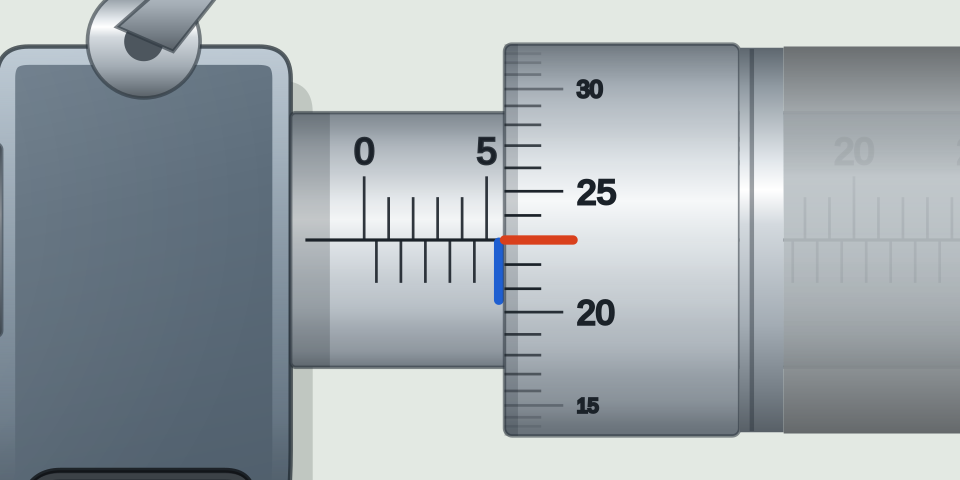
- Whole millimetres: the last numbered or whole-millimetre line above the reference line that the thimble edge has uncovered: 5 mm.
- Half millimetre: if a half-millimetre line below the reference line shows after it, add 0.5 mm: 5.5 mm.
- Thimble: the line on the reference line, 23, × 0.01 mm = 0.23 mm. Add: 5.5 + (23 × 0.01) = 5.73 mm.
When no half-millimetre line shows
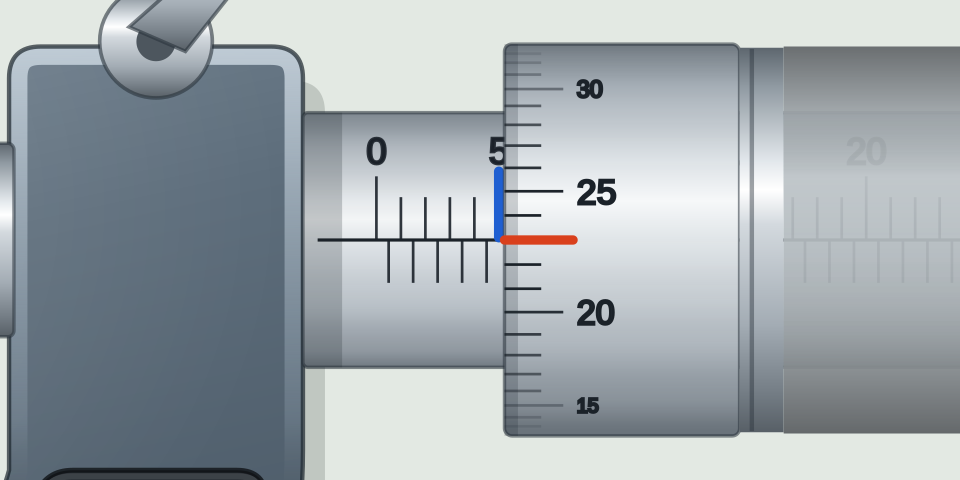
Here the edge has passed the 5 mm line but not the half-millimetre line after it, so nothing is added: 5 + (23 × 0.01) = 5.23 mm. Adding 0.5 mm would give 5.73 mm, a common slip. A useful check: the thimble reads 0 to 49 in the first half of each millimetre, and again in the second half.
Between two lines
When the reference line falls between two thimble lines, take the nearer one. Wikipedia's worked example has the thimble at about 27.9 divisions after 5.5 mm; read to the least count that is 5.5 + (28 × 0.01) = 5.78 mm. Some machinists estimate the tenth of a division (5.779 mm), but a school reading is written to the least count.
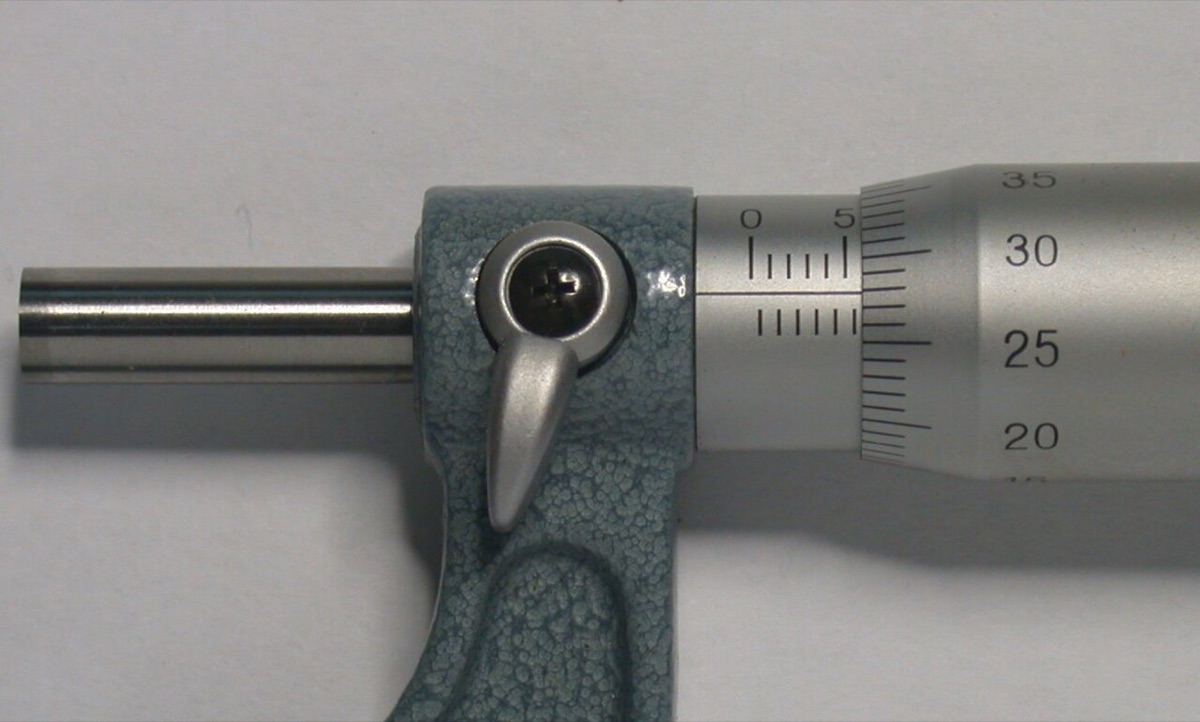

Micrometer and school screw gauge
The same opening, 5.73 mm, reads 5 + (73 × 0.01) = 5.73 on a school screw gauge (1 mm pitch, 100 divisions) and 5.5 + (23 × 0.01) = 5.73 on this micrometer. Both have a least count of 0.01 mm; they only split the millimetre differently. The screw gauge guide covers the school instrument and the inch micrometer guide the 0.001 in one.
Practise
- Read a micrometer: five readings with feedback that names the half-millimetre slip.
- Close to a line: readings where the thimble is nearly a whole turn.
- Open this reading and press Show me how.
Questions about reading a micrometer
How do you read a micrometer screw gauge?
On the metric micrometer shown here, start with the last uncovered whole-millimetre line. Add 0.5 mm if the half-millimetre line after it is also uncovered. Then multiply the circular-scale division on the reference line by the least count and add that to the main-scale reading. For example, 5.5 + (23 × 0.01) = 5.73 mm.
What is the least count of a micrometer?
A metric micrometer with a 0.5 mm pitch and 50 thimble divisions has a least count of 0.5 ÷ 50 = 0.01 mm.
Why does the micrometer thimble only go up to 50?
One turn moves the spindle 0.5 mm, so the thimble needs 50 divisions of 0.01 mm to cover one turn. Two turns make a millimetre, which is why the sleeve has a half-millimetre line between the millimetre lines.
Can you read a micrometer to 0.001 mm?
A standard micrometer reads to 0.01 mm. A vernier micrometer has a vernier scale on the sleeve that reads 0.001 mm, and a digital micrometer shows it on a display. Estimating a fraction of a division by eye is possible but is not a reading to the least count.
Sources
- Micrometer (device), Wikipedia (revision 1383763912). Checked 22 November 2026.
This site is independent and is not affiliated with any maker of measuring instruments.