Inside micrometer: how to read and use one
On this page
An inside micrometer measures inside sizes: the bore of a cylinder, a bearing or a bushing, or the inside of a ring. Its head reads exactly like a micrometer screw gauge. The difference is that the size is the head reading plus the extension rod fitted to it.
What is in the set
- A micrometer head: a sleeve and thimble, read like an inch micrometer (each thimble division 0.001 in) or a metric one.
- Extension rods: interchangeable, each covering one step of range. On an inch set they usually go up in 1 in steps: 1 to 2 in, 2 to 3 in, and so on.
- A spacing collar (0.500 in on an inch set) that fits between the rod and the head to extend the range.
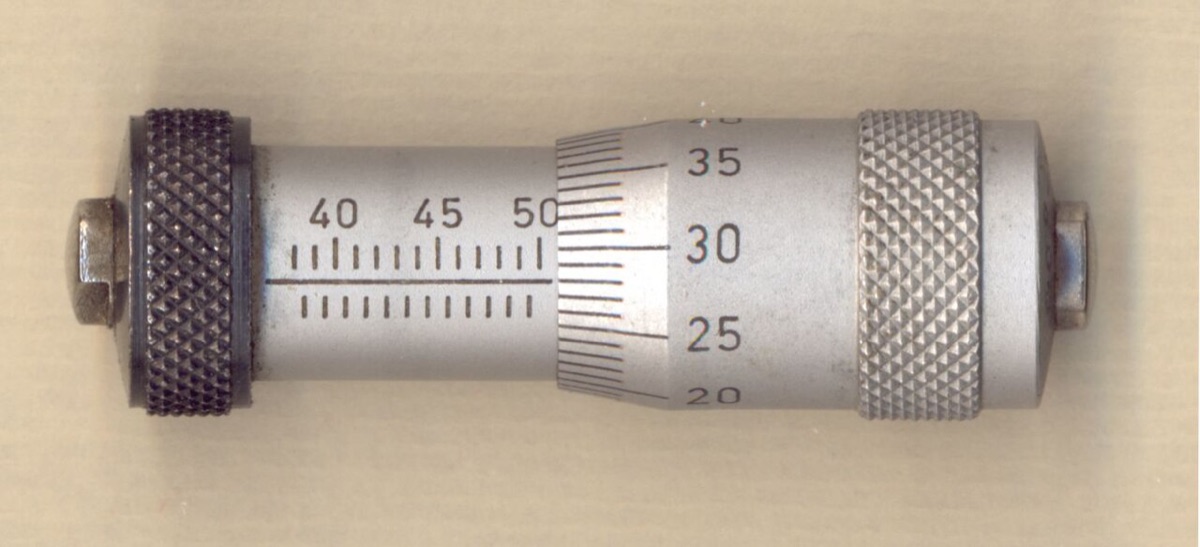

How to read it
- Read the head exactly as you would an outside micrometer: sleeve, then thimble, then add.
- Add the rod: the start of the rod's range. With the 1 to 2 in rod and the head at zero, the ends are exactly 1.000 in apart.
- Add the collar if it is fitted.
A worked example
- The head reads 0.276 in.
- With the 1 to 2 in rod: 1.000 + 0.276 = 1.276 in.
- With the collar fitted as well: 1.000 + 0.500 + 0.276 = 1.776 in.
A metric inside micrometer is read the same way, in millimetres.
Finding the true diameter of a bore
An inside micrometer touches the bore at two points, so where it sits matters. Across a circle, the longest line goes through the centre: a reading off-centre is too small. Along the bore, a tilted micrometer reaches further than the diameter: a tilted reading is too big.
- Hold one end steady against the wall.
- Move the other end a little around the bore and adjust until the reading is the largest you can find.
- Move it a little along the bore and adjust until the reading is the smallest.
- The reading that is largest across and smallest along is the diameter. Repeat at a few places and in two directions: a bore can be slightly oval or tapered.
Inside, outside and depth micrometers compared
| Feature | Outside micrometer | Inside micrometer | Depth micrometer |
|---|---|---|---|
| Measures | An object between two faces | The inside of a bore or ring | The depth of a hole, groove or step |
| Sleeve numbers | Read what is left showing | The same as outside | Read what the thimble covers |
| Longer range | A larger frame | A longer rod: add its length | A longer rod: add what it adds |
| Finding the size | Close with the ratchet | Largest across, smallest along | Base held flat, rod to the bottom |
See how to read a depth micrometer for the one whose scale runs the other way.
The bore micrometer
A related instrument is the bore micrometer, which Wikipedia describes as "typically a three-anvil head on a micrometer base used to accurately measure inside diameters". Where an inside micrometer touches the bore at two points, a bore micrometer touches it at three.
Common mistakes
- Forgetting the rod or the collar: the head reading alone is only part of the size.
- Taking the first reading: off-centre it is too small, tilted it is too big. Find the largest across and the smallest along.
- Dirty ends or bore: wipe both before measuring.
Practise the head
The head is read exactly like an outside micrometer. Open 0.276 in on the inch micrometer, read it, and press Show me how to check each step.
Questions about inside micrometers
What is an inside micrometer used for?
Measuring inside sizes: the bore of a cylinder, a bearing or a bushing, or the inside of a ring. Its two ends reach across the hole instead of closing on an object.
How do you read an inside micrometer?
Read the micrometer head exactly as you would an outside micrometer, then add the length of the extension rod (and the spacing collar, if fitted). With the 1 to 2 in rod and a head reading of 0.276 in, the size is 1.000 + 0.276 = 1.276 in.
Does an inside micrometer read backwards like a depth micrometer?
No. Its head reads the same way as an outside micrometer. It is the depth micrometer whose sleeve is numbered the opposite way.
How do you find the true diameter of a bore?
Across a circle the longest line goes through the centre, so the largest reading across the bore is its diameter. Tilted along the bore the ends reach further, so along the bore you want the smallest reading. Adjust until the reading is largest one way and smallest the other.
Sources
- Inside Micrometer, US Navy training manual (Aviation Boatswain’s Mate F), reproduced by Integrated Publishing. Checked 22 November 2026.
- Micrometer (device), Wikipedia (revision 1383763912). Checked 22 November 2026.
This site is independent and is not affiliated with any maker of measuring instruments.